Our Journey (part 1)...to a diagnosis of dyslexia

I've been putting off starting this page for quite a while now, and I'm not really sure why. Maybe it is because as an educator, I felt like I was part of the problem over the years. Maybe it's because dyslexia isn't widely acknowledged or accepted. Maybe it's because I feel a little guilty that my child is now going to get help...when there are SO many other children that are struggling even more than him.
Whatever the reason...it has been hard for me to sit down and start this journey for you. But, now that I'm here.....let's get to it.
Our journey with dyslexia began when my son was in 3rd grade. (Though, looking back....there were signs much earlier. As early as his toddler years.)
Let me back up a little...to 1st and 2nd grade. When my son was in 1st grade I noticed that he was a struggling reader. As a teacher, I was bringing home guided reading books that I was preparing for my lowest group of struggling 1st graders in my classroom, and I decided to have my won first grade son read through the books. I was alarmed when he struggled to read the books. Throughout his kindergarten and 1st grade year none of his teachers had mentioned that he was struggling so I was very surprised and concerned. (Now I know this was due to the type of testing the school was using).
Then in 2nd grade the testing format changed and my son was identified as a high risk student. He finished the computerized test so fast though, that they thought he didn't try and just clicked buttons, so they made him redo the test. The second time he took a few minutes longer to complete the test (still got done way too fast) and his score still showed that he was high risk. But, because he was getting good scores in the classroom on reading comprehension tests, the concern wasn't as high for my son. Luckily, this is the year that I switched districts and began working at the same school that my children attended. This allowed me the opportunity to actually be a part of these conversations that were happening between teachers and to put in my two cents about how he really was a struggling reader and needed some extra help. I am SO thankful that my life path brought me to their school that year...as I am not sure if he would have been accepted into the intervention program had I not been available with additional input. And him being included in that intervention program in 2nd grade, actually was a factor in his diagnosis.
That brings us to 3rd grade. In the middle of third grade, after being in reading interventions for about a year, my son made enough progress to be exited from the intervention program. While I was happy that he had made progress, I was concerned that he still wasn't reading proficiently. So I brought up my concerns with his doctor. I asked if dyslexia might be a concern that we should look into. (I had noticed other concerning things in his writing with reversals and inability to spell simple words). The doctor said that we could contact the school if we were concerned about his reading progress and have testing done. Working at the school, I knew what this meant. We could request testing for special education.
Did you know, that as a parent, it is your right! If you are truly concerned about your child's progress in school, you can request an evaluation for special education testing, and the school, by law has to comply with your request.
Now, working over the years, with many students in the special education program, I knew that while my son struggled with reading, there is no way that he would qualify for special education services because his needs were not that severe. So, I decided not to pursue that option and never approached the school about testing. I don't know if that was the right decision or not...as I still am confident that he wouldn't have qualified for services through the school, but I now wish we would have addressed this concern back then in 3rd grade, when the issues first came up. Because, now we are left trying to remediate gaps that would have been much more age appropriate to fix at that age. But honestly, I don't think the resources were actually available back then and I'm not sure what kind of help he would have gotten anyways.
Alright...now moving on. My son continued to plug along, struggling with reading, but doing okay. Then, we got to 5th grade when the next concern came about. My son had gotten good grades throughout elementary school (another reason why no one realized he was struggling) until he had to write 5 paragraph essays in 5th grade. His teacher brought up the concern that he wasn't able to get much on paper and was having to stay in at recess a lot to finish his writing assignments. And then, when he did finish the work was not that great. To all of us adults, it seemed like my son just wasn't trying hard and didn't want to write, so he got some lectures from mom and dad about using his time wisely and to not be worried about the spelling of words (this was still very hard for him) and just get his ideas down on the paper. Knowing what I know now, that his struggles with writing were actually due to dyselxia and a processing disorder, I regret that we did not have him assessed medically at this time. This would have allowed him to enter middle school with accommodations in place. But...you don't know, what you don't know.
That brings us to the next step in our journey....middle school/6th grade. We got a letter at home during the summer before 6th grade that knocked us off our socks. Our son, who had struggled with reading and writing his whole life, had qualified (based on his district test scores) to be part of the advanced learning STELM program in middle school. WHAT?!?!?!?! How was that even possible??? I remember looking up his test scores to see how he had done.
Okay...the OCD in me just took over. ;-)
I was going to generalize his test scores....but I had to actually go dig them out of the files to be accurate. And, then I couldn't find the correct year so here I am generalizing the scores anyways. ;-) If I remember correctly, he scored in the advanced range for math and science, the average range for reading, and the minimal range for writing. His advanced scores are what allowed him to qualify for the STELM program.
So, then he began his three year journey through the STELM program, which I am very grateful that he had the opportunity to be part of. It helped him discover some things about himself....
- Yes, he struggled with writing and grammar
- Yes, reading was slow for him (but if he found the audio version of novels on line, he could listen as he read along)...and did okay on the assignments
- He was really good at math and science (and was grade advanced in both of those subjects)
- He seemed to be naturally inclined for technology subjects and excelled at things like coding, robotics, engineering
Being part of the STELM program allowed my son to see that you can struggle with reading and writing, and still be really smart and have strengths in other areas. I am grateful for this opportunity as it gave him a level of self confidence that I'm not sure he would have had otherwise.
Next, we travel through the uneventful years of middle school and high school. Nothing much changed for my son. Reading was still slow and writing was still really hard, but he was doing well and getting good grades in school. Every parent-teacher conference pretty much yielded the same comments. He was really quiet and well behaved. He did his work on time but it was usually pretty short and to the point without much elaboration or detail. His participation in classroom discussions was pretty much nonexistent...(we always thought this was shyness, but now we know it is part of his processing disorder).
Around 8th grade or so I brought up the topic of dyslexia with my son. I told him that I had noticed that he struggled with reading and writing (even though he was really good at science and math) and that it was something we had noticed when he was younger. I bought up a checklist online of typical signs of dyslexia and had him look it over. He was surprised when he could answer yes to almost everything on the checklist. I asked if it was ever something he would like us to get checked out. I let him know that we didn't get him tested in school, because we knew he wouldn't need special education services, but that we could go to a medical doctor to get the tests done. At that time, he decided that he didn't feel the need to get testing done, but thought he'd think about it for the future.
That brings us to the end of his freshman year of high school. The first time that his struggles had affected his grades. The way things are done in his school, he pretty much has all the time he needs to finish tests and assignments. It's not a big deal if they need extra time, so it wasn't a problem that his reading and writing were slower. But, then in one of his high school classes he had an essay assignment that they had only 1 hour to plan and complete during class time. Being parents who check grades regularly...we were hounding him about why he had gotten a score of zero on his essay. That's when we realized the degree of his struggles and how he would probably need extra accommodations in college. He told us that on this particular project they had 60 minutes to plan and complete their essay. He said he was trying really hard, but it's hard for him to plan and organize his thoughts before he writes. He told us that by the time he had planned what he wanted to write it had already been 50 minutes...and he only had 10 minutes left to actually write the essay. That's when we realized we might be dealing with some processing delays that needed the accommodation of additional time. I'm very grateful that this assignment was given because it helped us kick things into gear and start the process for official testing of dyslexia. That process is not easy, or fast. Below I will detail the steps we had to take to get a diagnosis of dyslexia for our son to qualify him for the additional time that he needs
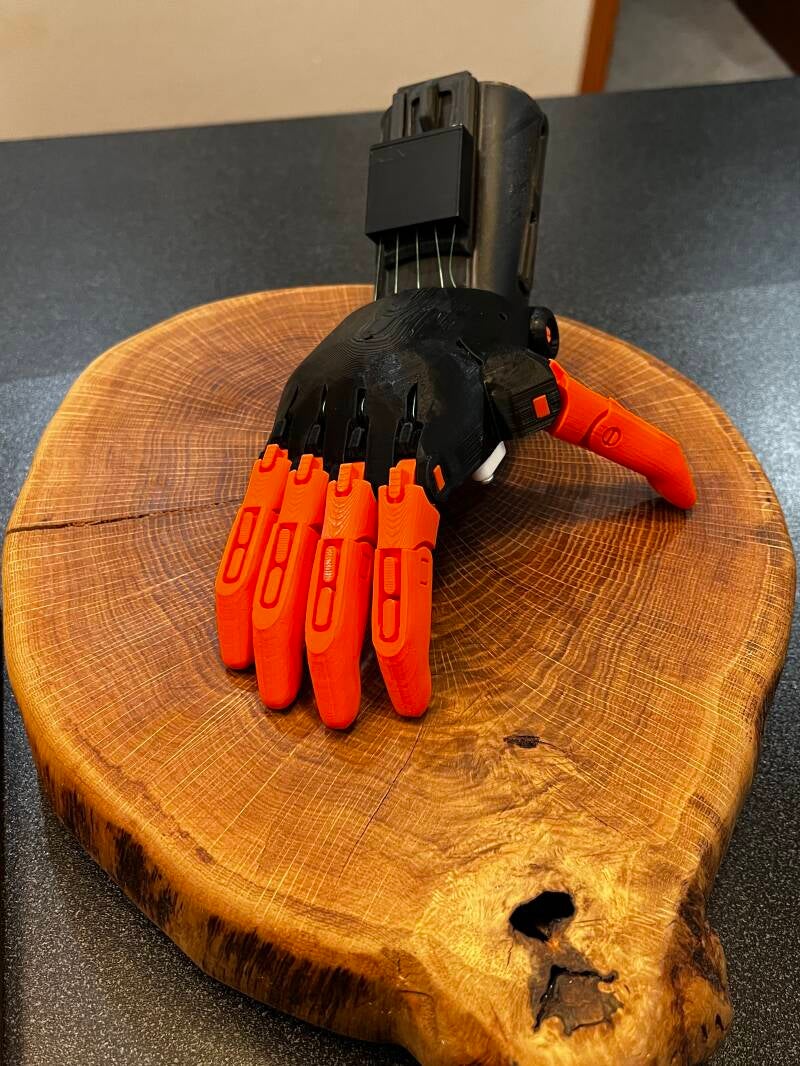
If you're curious to "see" what dyslexia looks like in a child.
Dyslexia is a 16 year old boy struggling to write "ice cream" on our family grocery list because he knows there is an "r" in the word, but he just can't remember if it goes at the beginning or the end.
But...it is also an 8th grade boy in STELM class that finished all his work before his classmates because they were doing the hands on part that he is good at...and now has some free time on his hands.
So... he chooses to go online and find a 3D printing plan to try and make this robotic hand on his school's 3D printer, just because it's fun and interesting to him.
Kids who are dyslexic have incredible strengths that deserve to be celebrated...just like this! The way his mind works to be able to create things like this just amazes me.
Our timeline to a diagnosis of dyslexia
| Date: | Event: |
|---|---|
| July 8, 2022 | Made an appointment with his family doctor to discuss our concerns and request dyslexia testing |
| July 2022 | This appoinment was cancelled due to staffing shortages. We had to find a new family doctor. |
| August 5, 2022 | Met with a brand new doctor to explain our concerns and request testing. Thankfully she saw the need! (Hint...it has to be a concern that has been around for awhile...not something new that you've just noticed.) This doctor referred us for a speech and OT evaluation. (Not the dyslexia testing yet....the speech and OT evaluation would let the doctor know if dyslexia testing was warranted.) |
| August 30, 2022 | Took my son to our local pediatric clinic to get his evalutions in speech and occupational therapy completed. He had to miss his second day of school to get these evaluations done. They said that was the only opening they had, and if we didn't come then they wouldn't be able to get us on the schedule. |
| September, 2022 | Waited to hear back from the speech and OT doctors to see if they would recommend further testing. Finally heard back from them and OT would like to see an additional evaluation done. They wanted him to get a special vision test done to make sure that it wasn't a vision issue. This special vision doctor also had a dyslexia screener that they could test him with. |
| September 20, 2022 | Traveled an hour and half to the only vision specialist in the state that does this type of screening. His vision was fine...but it was hard for his eyes to focus effectively. They recommended vision therapy. They also did the dyslexia testing with my son and "diagnosed" him with dyslexia. But I suspected that this assessment wasn't thourough enough to count as an official dyslexia diagnosis. We decided to pass on the vision therapy (it wasn't covered by insurance and we'd have to drive an hour and a half twice a week to attend)....I'm glad we did. When I asked his neuropsychologist about vision therapy she looked at me like I was crazy and asked... "How is that supposed to help? I don't believe in stuff like that." |
| October 2022 | Met with his OT doctor that did the initial evaluation and shared the results of the vision testing. She agreed that yes, she did recommend further testing for dyslexia and sent that message to his family doctor...who then had to leave a message with Marshfield to call us and schedule an official appointment with neuropyshchology in Marshfield. |
| October/November 2022 | Attended a few different OT appointments to try and work on helping his eyes focus better. She gave us activities to try at home, and we did for awhile, but they all seemed pretty silly and juvenile for a 16 year old, so it was a struggle to get him to do them. I'm still not sure if any of these activities were helpful or not....or if we were just wasting our time. After about 3 appointments we got a letter from our insurance saying that none of the speech/evaluations or appointments had been covered by insurance...so we cancelled our future appointments and began our first, of many, discussions with the insurance company about what would be covered during this process. |
| November 2022 | Our official appointment was scheduled for December 27th for his dyslexia testing. We would have to drive to Marshfield to go through a series of evaluations with mutliple doctors. This whole process would take about 4 hours. |
| December 19, 2022 | Neuropsychology in Marshfield contacted us and let us know that our insurance company wouldn't cover the scheduled appointment for testing because we hadn't met with the neuropsychologist yet to have our consultation. (The consultation was the first thing that was going to be completed during our upcoming appointment). So, we had to quick schedule a virtual meeting to meet with the neuropsychologist to complete the consultation appointment ahead of time. |
| December 20, 2022 | I had to take time off work to meet with the neuropsychologist at the last minute to try and get the virtual consoltation done. She asked a lot of questions and got a lot of history from us. I went through the history of our concerns, and at the end of our conversation she kept asking leading questions...about if there was anything ELSE we were concerned about? I could tell that she was trying to hint at something, but I'm not very good at picking up on the clues, so I was thankful when she finally came out and just said it bluntly. She told us that insurance companies will almost never cover dyslexia testing if it is only for academic reasons. They figure that is an academic problem and should be handled by the school. I let her know that I had already considered that option, but knew that he wouldn't qualify so we weren't pursing testing by the school. She kept reitterating that the school was obligated by law to test if we requested it...and I couldn't figure out why she wouldn't let the subject go. Finally, I realized (after I came right out and asked her)...that if the school did the testing and he didn't qualify, she would be able to use their results in her evaluation (as long as they were recent) in her dyslexia evaluation. I had already told her that I was willing to pay out of pocket if necessary and she was trying to find a way to save us some money. I was very grateful for this idea, and that became my plan....if insurance denied our request for testing. Luckily for us, we did have another concern....how his speed of processing might be affecting his ability to have quality friendships and relationships with his peers. We left that virtual meeting with our fingers crossed...figuring that chances were high that insurance would deny our request and we would be stuck paying out of pocket for the testing. And knowing that we would probably have to cancel his testing appointment (one week away) because insurance wouldn't be able to get back to us in time (it was Christmas week after all). That would put us on a very long wait list to get another appointment scheduled. |
| December 27, 2022 | A Christmas miracle!! I don't know how it happened, but all the pieces rolled into place and insurance got back to us in time for our appointment. And by some great fortune of ours...insurance was actually going to cover the dyslexia testing! I couldn't believe our luck! So, we made the trip and headed to Marshfield for a long day of testing. At the end of that day we were able to breathe a sigh of relief, when after 3 hours of meeting with doctors, my son finally had a diagnosis of dyslexia. |
| January 2022 | The joy of insurance covering the cost of testing was short lived....when we realized that they would cover the costs....AFTER we met our deductible. We were not even close to meeting our deductible yet, so essentially...we would still have to pay out of pocket for all of the testing. And, we did it at the end of the year, so our deductible would start all over again and nothing that we were paying would help us for future bills. Knowing that...I kind of wish we would have postponed the testing by a week or so. But, I am thankful that it is done and that we are finally able to move on with the next step....ACCOMMODATIONS with a 504 plan. ;-) |
Create Your Own Website With Webador